
Crack Sealing vs Crack Filling: Why the Crack Type Matters
4 min read · Updated October 2026
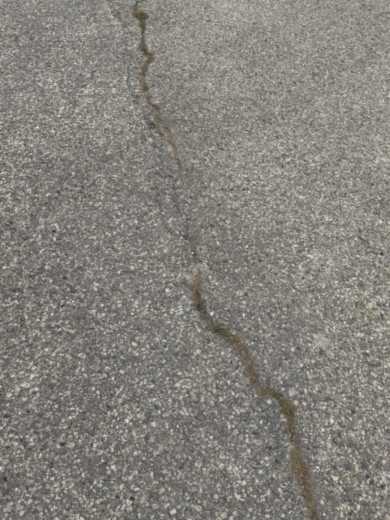
Crack sealing is for “working” cracks that open and close with temperature, generally 3 mm of movement or more. It uses flexible, specialized sealant, often in a routed reservoir. Crack filling is for “non-working” cracks that barely move. It uses simpler materials to keep water out.
Working vs non-working cracks
Pavement engineers sort cracks by how much they move. Transverse cracks, the ones running across a lot or road, open in winter as the asphalt shrinks and close again in summer. Those are working cracks. Longitudinal cracks along paving joints usually move far less.
| Crack type | Typical movement | Treatment |
|---|---|---|
| Transverse (thermal) Across the lot, evenly spaced | Working, about 3 mm or more | Crack sealing, often routed |
| Longitudinal Along paving joints | Usually non-working | Crack filling or sealing |
| Block / alligator Interconnected pattern | Structural failure | Patch, mill or repave |
What crack sealing involves
- Routing cuts a clean, uniform channel along the crack so the sealant has room to stretch. Colder climates with bigger temperature swings need wider routs.
- Cleaning and drying with compressed air and a hot-air lance.
- Hot-applied rubberized sealant poured into the reservoir, sometimes with a thin overband across the top.
What crack filling involves
- Cleaning out the crack
- Filling with hot or cold product, usually without routing
- Striking it off flush with the surface
Filling costs less per metre but doesn’t hold up as well on cracks that move.
Which does your lot need?
Most Alberta lots have both. The practical answer is to seal the transverse and wide cracks with hot-applied sealant, fill the minor ones, and flag alligatored areas for patching. We map this during the assessment so you only pay for the treatment each crack needs.
Send photos or book a walk-through, and we’ll mark what to seal, what to fill and what to patch.
Related guides
Sources
- FHWA-RD-99-147, Materials and Procedures for Sealing and Filling Cracks in Asphalt-Surfaced Pavements, via the National Center for Pavement Preservation